
03 / 07 · Boise install guide
Flooring Acclimation in Boise
Wood floors adjust to the air they live in. In a semi-arid valley with a long heating season, letting that happen before the install, not after, is the difference between tight seams and winter gaps.
What acclimation actually is
Wood is always trading moisture with the air around it. Put a board in humid air and it absorbs water and swells across its width. Put it in dry air and it gives water up and shrinks. Eventually it reaches a balance point, called equilibrium moisture content, that matches the temperature and humidity it's sitting in.
Acclimation is just letting the flooring reach that balance point for the room it's going into before it's fastened down. That's it. The common mistake is treating acclimation as a number of days. Three days in a cold garage teaches the wood about the garage. What matters is that the wood ends up close to the moisture content it will live at, and the only reliable way to know is to measure it.
Why the Treasure Valley is different
Boise is semi-arid. Outdoor air is dry for much of the year, and through winter a forced-air furnace dries indoor air further still. Wood flooring often ships from mills and warehouses in more humid regions, so when it arrives here it usually has moisture to lose.
Install that wood before it gives up the extra moisture and it keeps shrinking in place. The result is gaps between boards in the first heating season, sometimes wide enough to catch dirt. The reverse can happen too. Wood installed during the driest weeks of winter, in a house kept very dry, may swell and cup when summer humidity rises or when someone starts running a humidifier.
A useful reference point
At typical indoor temperatures, wood in air around 30 to 50 percent relative humidity settles at roughly 6 to 9 percent moisture content. Your flooring maker's instructions give the range they expect; use theirs.
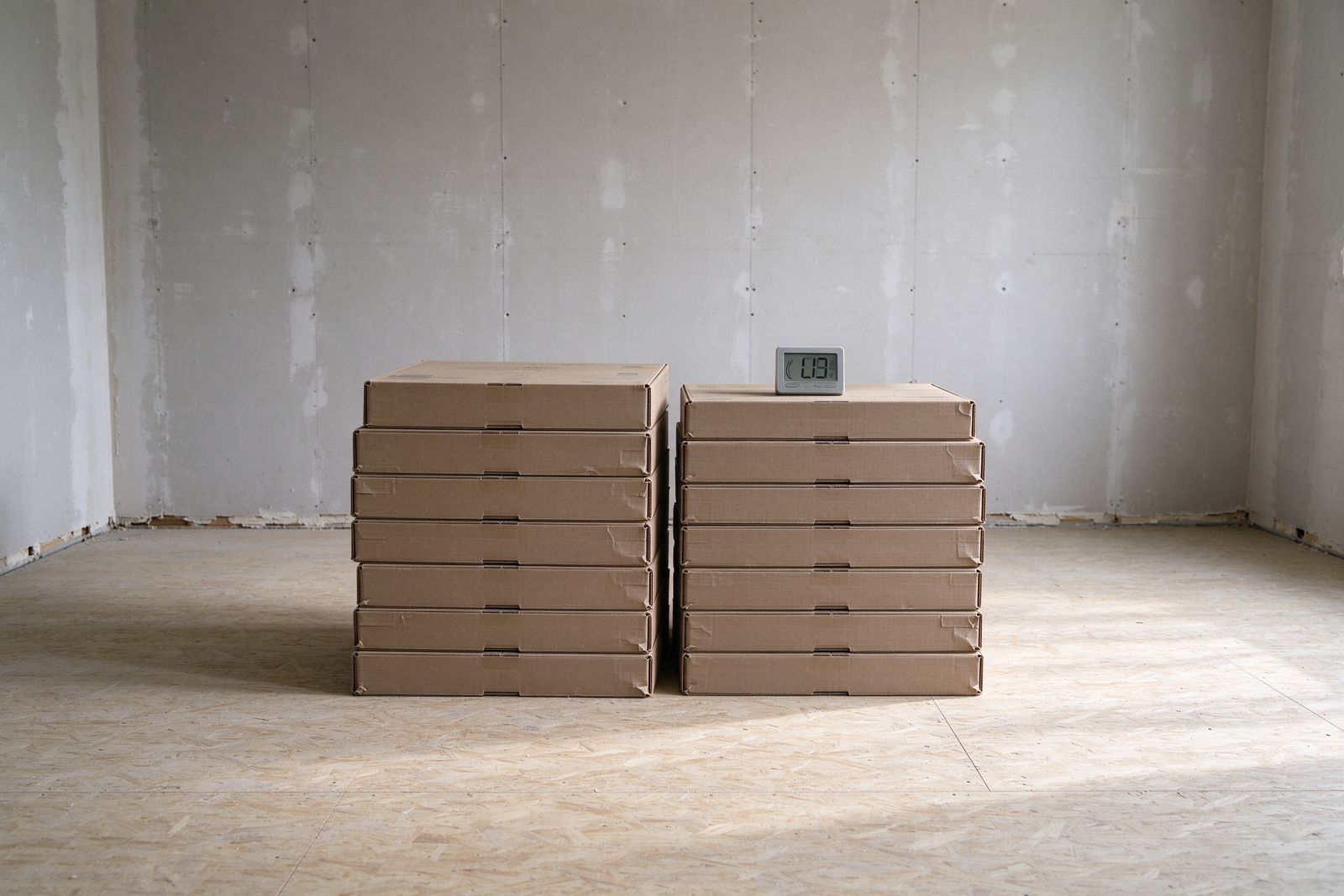
Acclimation in three acts: deliver to the room, wait with the heat on, measure before the first board.
Deliverto the room.
Not the garage, not a cold basement. Into the space it will be installed in, with the cartons off the slab.
Waitwith the heat on.
The house runs at normal living temperature and humidity, HVAC on, windows and drywall work finished.
Measurethen install.
Meter readings on boards and subfloor decide when it's ready, not the calendar.
Doing it properly
Get the house ready first
Flooring should arrive after the wet work is done. Drywall mud, paint, new concrete and tile setting all release moisture into the air. Wood acclimating in a house full of fresh drywall compound is acclimating to conditions that will be gone in two weeks. The heating or cooling system should be running at the settings the household will actually use.
Store it where it will live
Cartons go into the room or an adjoining room with the same conditions, raised off a concrete slab and spaced so air can move around them. Some makers want boxes opened or the planks cross-stacked; others want them sealed until install. Follow the product's instructions, since they vary.
Measure, don't count
A pin or pinless meter on a sample of boards, taken over a few days, shows when readings stop changing. Compare them with the subfloor readings and with the range the manufacturer gives. When the numbers stop moving and fall inside the range, the wood is ready. Sometimes that's a few days. Sometimes, with very wet stock or a very dry house, it's longer.
What each material needs
| Material | Moves with humidity? | Typical acclimation approach |
|---|---|---|
| Solid hardwood | Yes, the most | Measured acclimation to the home's living conditions; readings recorded |
| Engineered wood | Less than solid | Varies widely; many makers still ask for a period in the room |
| Laminate | Some, through the fiberboard core | Commonly a set period in the room in unopened cartons |
| LVP / rigid core | Very little with humidity, some with temperature | Often a short period at room temperature; some products need none |
| Tile, carpet | No | Room temperature for setting materials and adhesives |
Temperature is the forgotten half for vinyl. LVP delivered from a cold truck in January and installed straight away will expand as it warms up, and a floating floor that's been fitted tight to the walls has nowhere to go. That's one of the ways vinyl floors buckle.
After the install: living with a wood floor here
Acclimation gets the floor in at the right moisture. Keeping it stable is a household job. Many wood flooring makers ask that indoor humidity stay within a set band, commonly somewhere between 30 and 50 percent, to keep the warranty intact. In a Boise winter that often means a humidifier, either whole-house on the furnace or room units.
Some seasonal gapping in solid wood floors is normal, especially with wider boards, and closes again as humidity returns. Gaps that don't close, cupping (edges higher than centers) or crowning (centers higher than edges) point to a moisture problem worth investigating before anyone sands. For the wood-versus-vinyl decision itself, see the flooring types comparison.
Acclimation readiness checklist
Is the house ready for the flooring?
Tick what's truePlanning around a delivery date?Add the date the house will be ready to the quote form so the request reflects it.
Request an install quoteQuestions
Acclimation questions
How many days should hardwood acclimate in Boise?
There is no single number. The wood is ready when moisture readings stop changing and fall inside the range the manufacturer specifies for the home's conditions. That can take a few days or considerably longer.
Does LVP need to acclimate?
Many LVP products ask for a short period at room temperature so the planks are not installed cold. Some rigid-core products say none is needed. Follow the specific product's instructions.
Why do my wood floors gap every winter?
Dry winter air pulls moisture from the boards and they shrink. Some seasonal gapping is normal in solid wood. Keeping indoor humidity in the range the maker recommends reduces it.
Can I store flooring in the garage until install day?
It is better not to. A garage is colder and its humidity is different from the living space, so the wood acclimates to the wrong conditions.
Next step
Schedule around the wood
Acclimation adds days to a project. Put your target dates in the quote form and it can be planned in from the start.
Open the quote form